
Hairline cracks along ceiling joints, sagging bulkheads, and surface popping are among the most frequent complaints homeowners and commercial tenants face in the UAE.
The United Arab Emirates presents a challenging operational climate for gypsum ceilings: extreme summer outdoor temperatures exceeding 45°C contrast sharply with continuous indoor air conditioning (20°C–22°C). This rapid thermal cycling, combined with coastal humidity in Abu Dhabi and Dubai, causes materials to expand and contract continuously.
The Root Causes of Ceiling Cracks in the UAE
Based on our 11+ years of site execution across thousands of UAE projects, ceiling cracks almost never result from bad paint; they stem from structural errors beneath the surface:
1. Substandard Lightweight Wire Suspension
Budget contractors frequently suspend ceilings using thin tie wires anchored with light plugs. When central AC fan coil units blow air, the pressure differentials cause wire movement, resulting in stress fractures at board joints.
2. Incorrect Gypsum Board Selection
Using regular white plasterboards in humid areas like bathrooms, kitchens, or semi-exposed villa lobbies causes moisture absorption, board swelling, and joint separation. Bathrooms and kitchens strictly require green Moisture-Resistant (MR) plasterboards compliant with ASTM C1396.
3. Neglecting Thermal Expansion Joints
Gypsum expands and contracts over large surface areas. Any continuous ceiling expanse exceeding 9 to 10 linear meters without a dedicated expansion joint will crack at its weakest seam.
4. Poor Joint Taping & Hurried Compound Drying
Using cheap self-adhesive mesh tape instead of high-tensile fiberglass paper tape, or applying thick single coats of filler rather than three graduated coats, guarantees cracking within 6 to 12 months.
The NASAQ Standard for Crack-Free Ceilings
Our engineering teams implement a strict 5-point protocol on all Abu Dhabi and Dubai sites:
| Engineering Stage | Common Market Practice (Risky) | NASAQ Standard (Crack-Resistant) |
|---|---|---|
| Framing Steel | 0.35mm light gauge channel | 0.50mm – 0.70mm heavy galvanized steel studs & channels |
| Suspension System | Flexible tie wires | Rigid galvanized threaded rods with heavy-duty anchors |
| Wet Area Boards | Standard white plasterboard | Knauf / Gyproc Green MR (Moisture Resistant) boards |
| Joint Reinforcement | Self-adhesive open mesh tape | Embedded high-tensile fiberglass perforated paper tape |
| Finishing Protocol | 2 quick coats of joint filler | 3 graduated compound coats + Level-5 skim coat for cove lighting |
Why Level-5 Finishing Matters for Concealed LED Lighting
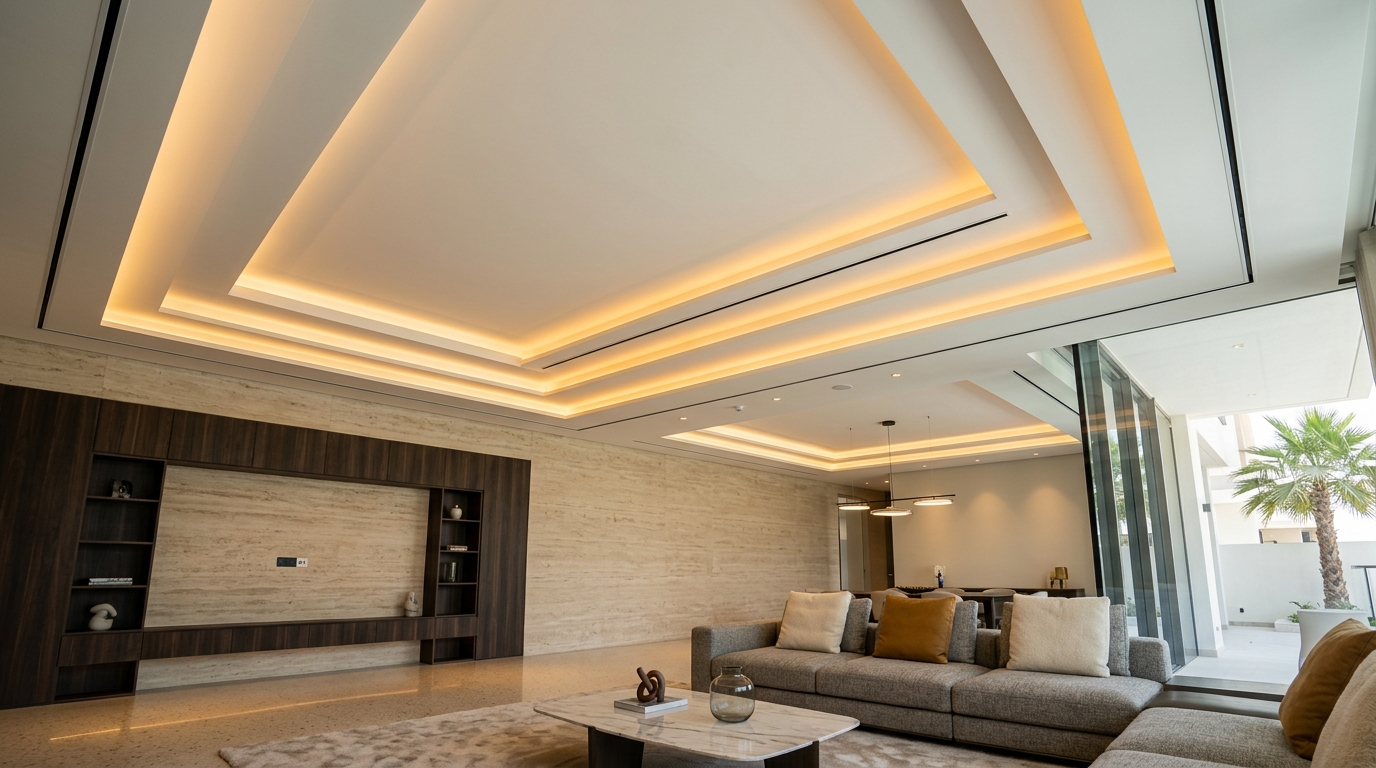
Concealed cove lighting casts grazing light directly across the ceiling surface. Any microscopic bump or joint depression casts visible shadows. A complete Level-5 skim coat creates an optically flat plane that remains seamless under warm architectural LED illumination.